|
Gastroenterologist, the candidate of medical sciences, senior lecturer Nikolay Petrovich Akimov:
10-12 % of the Russian population, almost each fifth woman and each tenth man, now suffer from a bile stone disease. And the number of such patients almost doubles every ten years. This illness doesn't look at the age – no matter if you are a student or a pensioner. And after 40-45 years old the number of diseases grows.
The cases of a bile stone disease appeared to have been described in a detailed way many centuries ago by Hippocrates and Avicenna. And nowadays modern scientists discovered bilious stones in the Egyptian mummies. In Ancient Russia bilious stones were also known – they were used as an ornament of women of fashion.
Now the highest level of a bile stone disease is marked in the developed countries of Europe, in the USA and Canada . Physicians consider that occurrence of diseases is connected with life conditions and food character. A bile stone disease is more frequent in those countries where much fat and substances rich in cholesterol are consumed.
What is a bile stone disease? What are its symptoms and reasons? How is it treated?
A bile stone disease is a chronic disease which is caused by formation of stones in a gall bladder and biliary ducts.
The course of illness varies, the clinical picture is also various. Approximately half of patients live easily for many years and even do not suspect about their disease (a so-called low manifestation, that is an asymptomatic course of illness). Stones in a gall bladder can not display themselves in any way for five and even ten years. But in other people – stones only start to be formed, and already – the severest colics. As a rule, an attack begins after fat, fried or spicy food.
The sense of a swelling in a stomach, a belch, bitterness in a mouth, a nausea, pains, heaviness in the right hypochondrium, a pain reflected an a collar-bone, a shoulder-blade, a shoulder – these symptoms of the disease though not being dangerous are still are unpleasant.
The major factor of a bile stone disease development is a disorder in a cholesteric and bilirubin metabolism in a human body and in a normal condition of bile, its physcolloid properties. Bile represents a physcolloid solution: crystalloids, albuminous substances, cholesterol, bilious acids, lecithin in a certain percent ratio. A disorder in a lecithin-cholesterol ratio in bile leads to sedimentation of a cholesterol crystal. Even the slightest change in a percent ratio of cholesterol, lecithin and salts of bilious acids (the basic components of bile) can cause cholesterol sedimentation and formation of stones. A small cholesterol crystal jams on an internal wall of a gall bladder on a mucous membrane in a fold and stays there – a cholesterosis of a gall bladder often feigning a polyp starts.
Another reason of the disease is a stagnation of bile because of development of a dyskinesia of a gall bladder. It hangs like a bag and is not reduced in a proper way, bile is not produced. The gall bladder is not reduced because of disorders in a nervous-reflex regulation of a gall bladder, some hormonal influences. When the food gets in a stomach, and from the stomach – into a duodenum, receptors perceive the chimus in its structure, the hormone of cholecistochinin is produced, which causes the reduction and the expel of the gall bladder. And now for some reason the hormone is produced in an insufficient quantity. Vegetative nerves also perform this regulation. Receptors have somehow changed, do not perceive the structure of food in a proper way. The gall bladder does not answer: there is no reflex influence to bile production. So it becomes stagnant.
A dyskinesia of a biliary tract is a disorder in synchronism of opening of valves for letting bile into a duodenum.
Deformations or anomalies of development of a gall bladder and a duodenum gut can also cause disorders in a normal bile outflow from a liver and a bubble into intestines. A biliary system is arranged as follows. The dynamics of bile outflow is: a biliary system has a number of valves, sphincters. Normally a sphincter is situated in the neck of a gall bladder and in the place of confluence of a general bilious stream into a duodenum. At a dyskinesia – an impellent malfunction of a biliary tract – the situation is the following: there is a lot of bile in a gall bladder, but valves do not function in a proper way, and bile supply of a duodenum is insufficient. The gut has receptors react to the structure of chimus which goes from a stomach. If the food from the stomach is fat (a fat chimus), a gall bladder produces maximum bile, because it should process, divide fat on fine pieces to let the enzymes of a pancreas split them. If the food is not fat enough, the need for bile is less.
In a non-adequately reduced gall bladder the function of valves is broken, it is emptied not completely, it looks like a bog – bile becomes stagnant, forms sediments, and on the background of a chronic inflammation a stone is formed. A bad gall bladder is a source of stones formation. It is characteristic for people with superfluous body weight – at them the fat is deposed not only on the front belly wall, but also in internal organs, including a biliary system and biliary ducts. Abdominal organs become close – an abdominal pressure rises. Bile outflow from a gall bladder becomes difficult.
The same occurs in women during pregnancy – the fetus grows and pushes internal organs. Bile production is broken and a stagnation of bile happens. And as soon as a single small cholesterol crystal forms a sediment, a stone begins to grow like a snowball. Moreover, biochemism also changes in women during pregnancy – physcolloid properties of bile. The level of bile cholesterol increases, consequently, it leads to a bile stone disease.
Stagnation of bile can also be caused by an inactive way of life.
Disorders in a rhythm and a character of nutrition are also important. When a person eats irregularly, 2 times a day instead of 3 or 4, as it is necessary, they have long breaks between meals, if they do not eat for a long time (consider the fact that bile is produced in reply to food consumption), the bubble is overflown, the liquid part is soaked up by a mucous membrane of the bubble, bile becomes dense, and the condition for formation of stones is created.
A hereditary factor is also important. Astenics - people of a thin constitution – suffer from a bile stone disease less often.
Hyperstenics (a person of a sporty built) have wide shoulders, they also usually have greater muscular weight, and their diaphragm is high. As the diaphragm is high, an abdominal pressure changes, the dynamics of bile production is broken. Certainly, it is not the only reason of a bile stone disease – there is a complex of factors. That means that externally huge "bodybuilders" are actually not so healthy. Besides that, they suffer from a hypertonic illness more often – they have a higher pressure. But it may happen that hyperstenics have lived all their life eating normally and having a low level of cholesterol, and – they go on living. Though they sleep a little, they are quickly restored.
But if to speak about astenics, they more often have such functional diseases as a hypotonia of a gall bladder, omission of a stomach, omission of all internal organs.
The risk of development of a bile stone disease does not depend on height. It also concerns tall people.
The next reason of a bile stone disease is infections and helminthic diseases. The people who have a virus hepatitis in an anamnesis suffer suffer from a bile stone disease more often, because lythogenity of bile increases, it changes physcolloid properties and becomes dense. Lamblia parasitize in a duodenum, irritating its mucous membrane, that reflexly leads to malfunction of a gall bladder and valves.
In most cases a person learns about the disease during the examination connected with some unpleasant feelings in a stomach area. They were examined and a bile stone disease was found. But sometimes there is an atypical clinic which feigns other diseases of abdominal organs, in particular, a gastritis and a stomach ulcer.
The clinic of all diseases of digestion organs has much in common – they are closely adjoined to each other, and differential diagnostics can be complicated. To diagnose competently, it is necessary to collect the anamnesis correctly. Helminthic invasion is now a rare disease. At a bile stone disease a pancreas is frequently involved in a pathological process as the function of these organs is interconnected. Cholecisto pancreatitis appears . A coprogram – a research of excrements – should be appointed to each patient in the beginning of the examination. It is possible to see not only the presence of helminthes and the elementary, but also fibers and fats digestion. It is a very important parameter. Not all doctors pay enough attention to it, and it is vain. If fat is not digested, there is a lack, in particular, of lipaza. It is dangerous not to pay attention to the stones which are hiding in a gall bladder. It can lead not only to colic attacks, but also to complications. It can cause a sharp cholecystitis, a mechanical jaundice, a pancreatitis, a cancer of a gall bladder.
There are conservative and operational methods of treatment of a bile stone disease.
It is possible to treat a bile stone disease non-operationally, without a surgical intervention. The majority of people (first of all doctors) consider that it is a surgical problem. Actually it is a therapeutic problem, but because of our insufficient developments in the field of therapy it is necessary to use surgical methods.
Surgeons deal with patients with already grave symptoms – a cramping pain, colics which can acquire a constant character and last from several minutes up to hours and even days. In some people it happens regularly, and someone has ‘attacks' only a few times a year.
If an attack has taken place, most likely it will be necessary to use a surgical treatment. A hepatic colic is a terrible symptom. It can have a sad end – a so-called empiema, or a gangrene of a bladder, can develop in a gall bladder. Only a surgeon will save a life.
However some patients have an attack only once, and then they live the rest of their life without pains.
But a surgical intervention does not destroy the reason of stones development. It is possible to remove a gall bladder with a stone. But stones are sometimes formed in a general biliary duct and in intrahepatic ducts because the reason is not eliminated. And after the removal of a gall bladder a so-called postcholecystomic syndrome sometimes develops – a person suffers in the same way as they did with stones in a bladder. Because biochemical changes in bile remain.
Isn't it impossible to live without a gall bladder? This organ is not vital. Bile is produced in a liver. 2 ducts go from it – from the right and the left part. They incorporate forming a hepatic duct. It is connected with a biliary duct of a gall bladder and a general biliary duct – choledoch – is formed. And it in its turn runs into a duodenum.
Bile is constantly produced in a liver. But at a removed gall bladder there is no spare tank in which it should be stored till a certain time. Without a gall bladder a person cannot afford a good meal, especially fat, with wine. They should follow certain restrictions. Of course, they will survive, but the stock of their durability of this kind is limited.
It is considered that stones can be crushed. This method of treatment – lythotripsia (crushing of stones) - has appeared to be ineffective and thus it is not applied. Many side effects, complications. "Splinters" of an irregular shape and sometimes with sharp edges appear while crushing and when such a fragment passes through a gall bladder and a bladder gut, a severe attack of a bilious colic appear.
If there are no attacks and a person has learned about stones in a gall bladder, there is an alternative – a conservative treatment. It is purposed to improve a bile biochemism (its physcolloid properties). It is necessary to normalize a so-called cholatocholesterol ratio. Stones are formed in a sour environment. РН -shift of bile in a sour side leads to the development of a bile stone disease (it concerns those who uses in food only fresh bakery products). РН of bile is defined during the research.
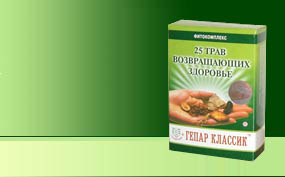
The herbal collection ‘Gepar' which consists of 25 powdered herbs has passed clinical tests and is now used for this purpose. The herbal collection has two methods of application – No. 2 to be used in a complex with olive oil, honey, a lemon and purifying enemas. Method of application No. 1 is also used – it is just a reception of powders by a certain scheme.
Bile-expelling medical products have a poor effect. They strength bile production, but they do not cure the disease. Because they do not affect on the mechanism of formation of bilious stones, physcolloid properties of bile vary little under their influence, the original reason remains.
The t reatment with the herbal collection is a procedure purifying an organism. Only a purified organism is able to restore itself. The herbal purification procedure is connected with the reception of five herbal powders during one night. Then the organism works by itself. Bilious acids formed in a liver keep cholesterol, calcium salts, lecithin in a dissolved condition. At an insufficient formation of bilious acids and stagnation of bile in a gall bladder calcium salts form sediments. And a long stay of stones in a gall bladder, bilious and hepatic ducts often leads to a hepatic insufficiency, an inflammation and a liver cirrhosis.
|